
Millard County Deed Records in the Title Trail
The Recorder is the county's chief custodian for anything that affects title to real property. Think of the online index as the entry point. The recorded instrument itself supplies the proof. Deeds, final judgments, claims, patents, and partition decrees all appear in the historical index finding aid. Mortgages, liens, and plats round out the county property records. Each does different work. Some record a transfer. Some place an encumbrance on land. Some describe lots or legal interests in a parcel.
| Deed Type | What It Does | Common Use |
|---|---|---|
| Deed | Records a conveyance and names grantor and grantee | Trace the transfer in the title chain |
| Mortgage or lien | Records a claimed security interest or encumbrance | Review recorded interests alongside a transfer |
| Final judgment | May affect a property interest or title status | Follow the court reference and recorded document |
| Claim or patent | Historical instrument types named in the archive index | Research older land history and references |
| Partition decree or plat | May divide or describe land and interests | Compare the filing with parcel geography |
Treat these as record categories rather than a promise of matching buttons in the live Tyler dropdown. The Recorder's portal may label its controls differently or list more document types. Confirm the actual search fields on the current interface, and keep the instrument's legal description with its recording reference as you go.
Millard County Grantor and Grantee Index Steps
Grantor and grantee indexes let you walk one recorded transfer back in time. Each index points to the one before it. Begin with the most recent deed you can identify. Note the party who received the interest. Then use that party's earlier acquisition to step back again. Repeat the process until the chain reaches as far as you need. The Recorder's live interface is the only reliable source for its exact search fields. Check the portal's controls when you begin a Millard County property search.
- Identify a deed reference by parcel description or a known party name.
- Read the grantee and the prior grantor named in the instrument.
- Search the earlier grantee entry and note its linked recording reference.
- Repeat, checking that each legal description still matches the property.
- When the online record reaches the pre-1987 boundary, request the earlier index or image from the Recorder.
- Grantor
- The party transferring an interest in an instrument.
- Grantee
- The party receiving the interest.
- Chain of title
- The sequence of recorded instruments used to trace successive transfers.
- Index reference
- A pointer to a document; it is not a substitute for reading the instrument.
This backward method answers prior-ownership questions. Current owner details belong with the Treasurer and Assessor, whose tax roll and property records show the present tax account.
Millard County's Pre-1987 Deed Image Boundary
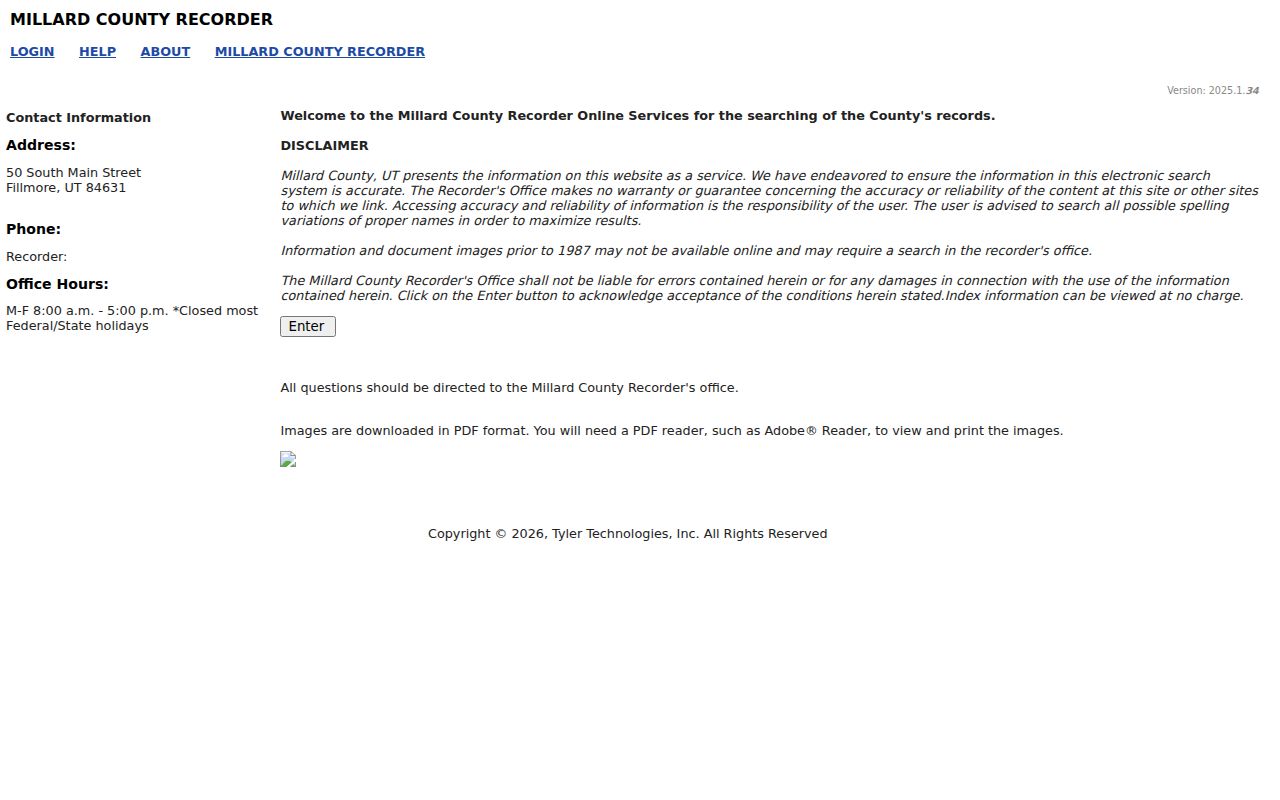
The Tyler landing page offers free index information and PDF document images. It also warns that information or images before 1987 may not be online. Read that year as an availability boundary, not as the Recorder's starting date. Older deeds may still sit in county holdings or in the historical index series. A search that returns no old image should prompt an office inquiry. It should not lead to a conclusion that no transfer occurred.
Before contacting the office, gather the name spelling, the parcel or legal description, any instrument number, and the online result that led you there. Ask whether staff can search by grantor, grantee, or property description. Also ask what copy formats exist. Copy charges are published separately, so confirm the fee for your exact request before ordering.
The official Millard County Recorder index page shows the online-services notice. It also carries the pre-1987 date warning.
When a deed predates 1987, connect the online reference to the paper or microfilm route before assuming a gap in the chain of title.
Utah Archives Series 6101 Preserves Millard Indexes
The Utah Archives catalog describes Series 6101 as seven microfilm reels. The reels hold Millard County Recorder grantor and grantee indexes. The finding aid says the index covers deeds, final judgments, claims, patents, and decrees partitioning or affecting title to real property. It lists party names and references to the underlying records. For Millard County property records research that reaches past the online index, this series is a direct archival path.
Remember that an index reel is not the deed itself. Use the series to find a name and record reference. Then request the actual instrument from the Recorder. Or follow the instructions in the Archives catalog. Spelling variations can hide older entries. So try the forms shown on later deeds as well as known variants. Seven reels of index will not cover every copy or image a full title review needs.
The Series 6101 finding aid gives the reel count and record scope.
Prior-owner questions are covered in more detail on the former-owners page. That page includes the backward chain and the online cutoff.
Reading a Millard County Grantor-Grantee Entry
Read a grantor-grantee index as an ordered set of references. The same person can appear as a grantee in one instrument. That person may later act as grantor in a transfer out. Party roles alone do not prove full ownership of the parcel. Compare the deed text and the legal description. Also compare any instrument that divided or changed the land. Keep the document number exactly as it appears in the Recorder system.
- Locate a recorded transfer that matches the parcel's legal description.
- Record the grantee and grantor names exactly as they appear.
- Search the prior grantee entry to find the earlier transfer reference.
- Check each document's legal description and recording date before continuing.
- Grantor
- The party named as transferring an interest.
- Grantee
- The party named as receiving an interest.
- Chain of title
- The sequence of recorded transfers and related instruments for land.
- Index vs instrument
- The index helps find a filing; the recorded document supplies its terms.
Utah Courts Xchange Is Separate From the Millard Deed Index
Utah Courts Xchange shows district and justice court case information to the public. It is not a title index. That difference trips people up. A court docket can still help a Millard County deed search, because the county's historical Recorder index includes final judgments and decrees that affect title. When a recorded instrument points to litigation, the case file adds context the land record lacks.
Work the two sources in order. Identify the parties or case reference first, then search Xchange for case detail, then turn to the Millard County Recorder for any instrument actually recorded against the property. A party name or case outcome is never a deed transfer on its own. Only the recorded instrument proves the transfer.
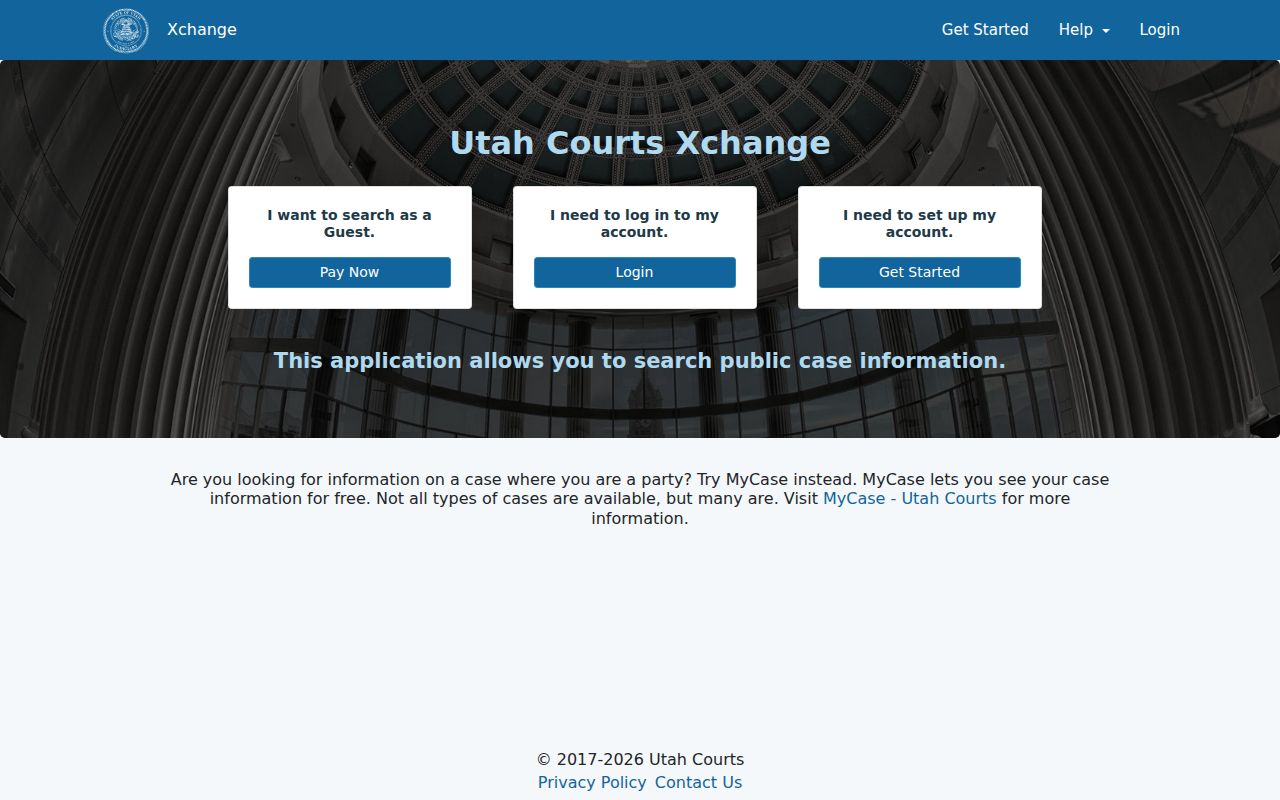
Court records live with Utah Courts and the court clerk. The Millard County Clerk does not hold them. Keeping the court file and the land record separate matters when you trace a chain of title or check a lien. Open the Utah Courts Xchange public case search to begin; the guest search interface appears on the main page.
Confirm any property transfer in the Recorder's instrument index and the document itself.
Millard County Recorder Fees and Copy Requests
Millard County's Recorder publishes a fee schedule with an effective date of May 6, 2026. A $45 document covers up to ten legal descriptions. Each extra description, mining claim, or water unit adds $2. A subdivision or condominium plat runs $55 per sheet. Every lot or unit adds $2 to that cost. A survey filing costs $40 per page, and a certificate under seal is $5. Recorded-document copies are $0.50 per page, while staff-prepared copies run $1 per page. Military discharge records and their copies carry no charge.
Those figures are published amounts, not a promise that every request costs the same. Confirm the current schedule with the Recorder before sending payment. A clear request names the document type, the parties, and the recording reference. It also lists the property description and whether certification is needed. The office sits at 50 South Main Street in Fillmore. Hours run Monday through Friday, 8 a.m. to 5 p.m. The office closes for most federal and state holidays. Call 435-743-6210 first to be safe.
Note: A certified seal authenticates the copy, but it does not create a title opinion.
Millard County Plats and Related Instruments
A recorded plat gives lot and block context. That context ties a deed description to a mapped parcel. In Millard County, the Recorder keeps the plats. Planning and Zoning handles applications and land-use materials instead. A P-1 planning application requires a Recorder plat. The plat must show the subject property and adjoining land within 300 feet. That requirement alone shows why plats matter for parcel research. Still, an online GIS line never replaces the recorded map or a licensed survey.
Cross-check the plat name, lot, block, or legal description against the deed. Splits and reconfigurations complicate things. An older instrument may describe a larger tract than the current tax account shows. Keep every plat and deed reference in date order. That way the boundary trail and the title trail stay separate.
Millard County posts subdivision and land-use paperwork on its official subdivision and land-use forms page. For the filed plat itself, the Recorder remains the source.
Requesting a Millard County Deed Copy
Start with the online index and note the document reference. If a PDF image is available, download it. Confirm the parties, parcel description, and recording details match. Pre-1987 records often lack an online image. In that case, contact the Recorder's office with the clearest identifiers you have. Walk-in counter service is listed at the Fillmore office. Confirm current arrangements and fees before you travel or mail anything.
Keep the copy request narrow. Include grantor and grantee names and an approximate recording date. Add the parcel number if known, the legal description, and the instrument reference. Say whether you need a plain or certified copy. For an older chain of title, the online index is only the starting point. Ask the staff how to reach older indexes or an Archives reference. One instrument usually answers the question, so skip requests for an entire property file.
Recorded, not guaranteed. The index points to filed instruments and may not show every unrecorded interest. A title professional reviews the chain and related records before making a title determination.