
Three Millard County Property Value Measures
No single figure follows a parcel through Millard County property records. The Assessor's market estimate values taxable real property. The taxable value shifts once classification applies. The last sale price comes from a recorded deed. Three numbers, three meanings. The Assessor's public property-information page routes visitors to the Recorder search. It does not lead to a separate assessor card. So check the source beside every number. Before quoting any value, note which office published it and what date it represents.
| Value | What It Is | Where |
|---|---|---|
| Assessor market value | County estimate of market value for assessment | Assessor valuation records |
| Taxable value | Amount after the applicable property classification or exemption | Assessor record and tax process |
| Recorded sale price | Consideration associated with a specific deed transfer where shown | Recorder instrument or related public record |
| Appraisal | Independent opinion prepared for a stated purpose | Licensed appraiser, not the tax roll |
A sale price covers one deal. An assessed market estimate follows the county's valuation process and property classification instead. It is not an asking price. The comparison helps you read a record correctly, not set an offer or a replacement cost.
Millard County Property Values Use a January 1 Valuation Date
In Millard County, every taxable property value gets a January 1 valuation date. The Assessor stamps it that way. That date matters. The value reflects the property on that single day. It is not a live estimate of what a seller might ask today. The county runs a detailed review every five years. Smaller annual adjustments fill the years between. Comparing a recent sale to an assessed value? Check the dates each figure represents, and whether the parcel changed in between.
The Assessor leans on three standard methods: sales comparison, cost, and income. Which one applies depends on the property itself. A residential parcel, a rental building, and bare land each call for different evidence. Value questions should go to the Assessor first. The Millard County assessment-process page traces how a valuation moves through appeals and tax collection.
A county value carries a January 1 date, so match it against a sale price from the same period.
Millard County Taxable Value Reflects Property Classification
Millard County classification changes the math. A primary residence is taxed at 55 percent of market value. Vacant land, commercial property, and second homes are taxed at 100 percent. The gap explains a puzzle. Two parcels with similar market values can carry very different taxable values. Farmland under the Utah Farmland Assessment Act is assessed on productive capability instead of market price.
The Assessor's real-property page publishes the county's own example. A greenbelt page covers the farmland questionnaire. The current parcel record and county instructions control treatment, so never assume an owner qualifies from a rural address. See the Assessor's real-property explanation for the county-specific example.
Bill, exemption, and appeal details are handled separately in the property-tax records guide.
Millard County Value Context Varies by Community
The Millard County General Plan sorts its communities by growth pace. Delta and Fillmore sit among the moderate-growth towns. Hinckley and similar agricultural communities move slower. That distinction is land-use context, not an appraisal report. No official city-by-city assessed-value time series exists for the county, and no fast-appreciating district is named.
So check value parcel by parcel. A countywide trend label will not hold up. For a Delta parcel, the city address grid, a recent plat, or a building permit may explain a change in use or improvement. Rural parcels run differently. For a small-town or rural parcel, agricultural classification and productive capability may matter more than a nearby residential sale.
In every case, market value belongs to the subject property and its valuation date. A growing-town label proves nothing. Neither does a postal city name.
Millard County Sale Price and Assessed Value Are Different Records
A sale price belongs to a transfer event. The Recorder keeps the deed. Each office answers a different question. A sale can inform a sales-comparison method. But it does not become the assessed value on the spot.
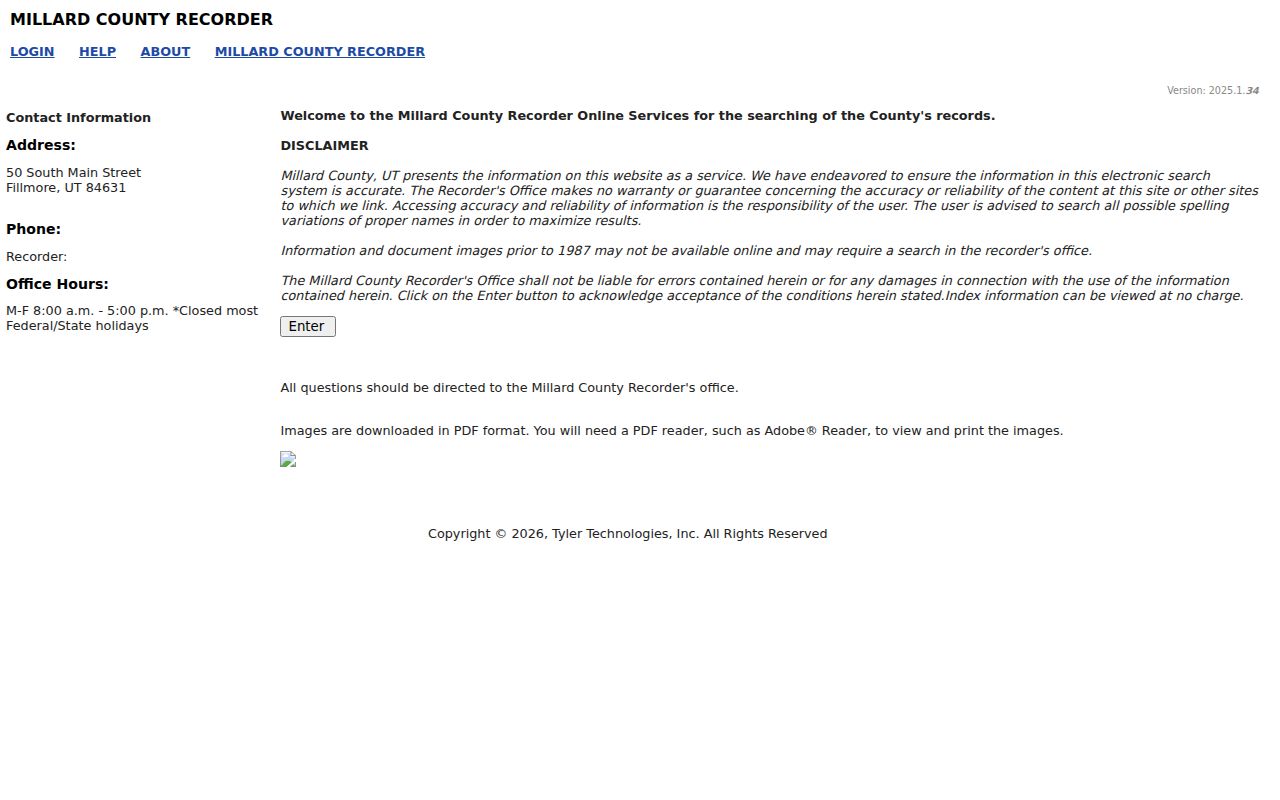
The Recorder's Tyler index offers free index information and PDF images. Pre-1987 material may require an office search. Read the legal description before treating a deed as a market clue. Partial-interest sales, family transfers, and mismatched legal descriptions rarely compare to an arm's-length sale. They seldom match a sale of the whole parcel. No county source guarantees a public sale-price field on an Assessor card. Confirm the document itself.
Use the Recorder's official index for a recorded transfer reference. Deed records and assessment records stay separate, and that separation is the point.
Save the instrument reference before comparing the transaction with the county's value record.
Millard County Value Records Need a Purpose-Specific Check
A public property value in Millard County supports the tax roll. It does one job. It is not an offer price. It will not price a construction project or stand in for an independent appraisal. A buyer, a builder, and an owner each need a different number. A tax bill shows what is owed. A recorded deed shows what changed hands. A plat map draws the lines, and an appraisal reports market value for one property.
The county's property-information page routes searches to the Recorder. No stand-alone value card sits behind it. Ask the Assessor which valuation record is official and what valuation date it reflects before trusting a third-party search result. Bring the parcel number and state the purpose of the request.
For the appeal calendar and tax-account questions, the Millard County property tax records page is the right stop.
Looking Up a Millard County Property Value
Millard County's Assessor property-information page points record searches to the Recorder. The Assessor publishes no separate public value card. There is no stable value-history URL either. Start with the parcel number. Ask the Assessor which valuation record exists for it. Then turn to the Recorder for the recorded deed behind any sale. A Treasurer account that displays a tax amount is not the full valuation record.
- Identify the parcel from the address using the local street grid and county or state mapping.
- Use the Assessor's published property-information route and ask for the valuation record for that parcel.
- Keep the January 1 valuation date and any stated review year with the number.
- Use the Recorder's latest relevant deed to identify the sale record, then compare the dates and descriptions.
- Market value
- The Assessor's estimate used to value real property for assessment.
- Taxable value
- The value after the recorded classification or applicable exemption.
- Sale price
- The consideration reported for a specific transfer, not a forecast of today's price.
- Reassessment
- A later valuation review under the county's annual and five-year work cycle.
What a Millard County Assessor Value Cannot Tell You
The Assessor's figure is a valuation for taxation. It is not a private appraisal. A buyer, seller, lender, or builder needs a document written for that purpose. Millard County may apply sales comparison, cost, or income approaches depending on the property type. None of those methods turns a parcel's record value into an individual appraisal, and a sale price can differ because the date, condition, market, and classification differ.
Value vs price. Millard County assessed market value is used for taxation and is not a promise of what the property would sell for. Obtain a licensed appraisal for a value opinion tied to a specific transaction or purpose.